

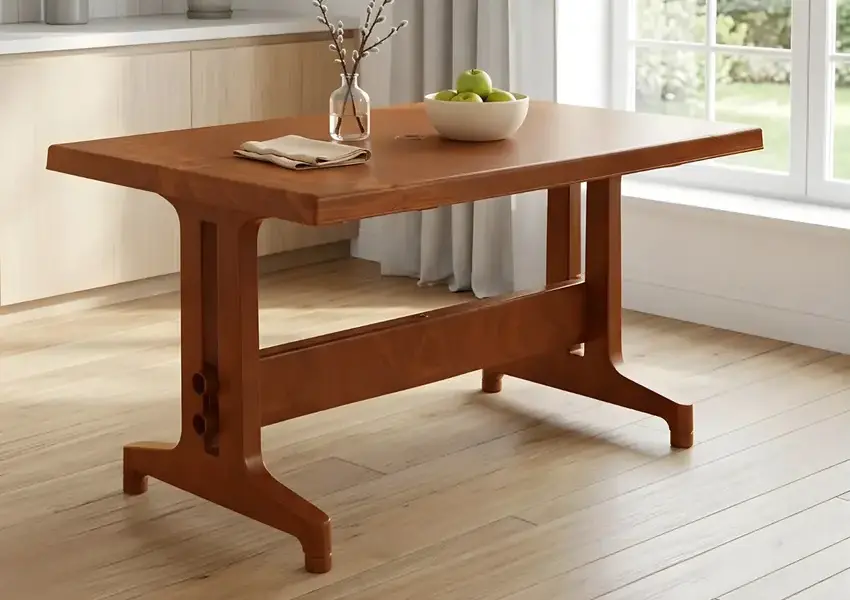
Medium-Density Fiberboard (MDF) is a darling of the modern furniture industry. It is smooth, has no knots, doesn’t warp like solid wood under temperature shifts, and offers an incredibly polished finish for a fraction of the cost. But if you have ever browsed home improvement forums, you’ve likely run across a terrifying horror story: an MDF board exposed to water that swelled up like a sponge, completely ruined.
So, can MDF get wet? The short answer is no, standard MDF does not handle raw moisture well. However, the complete answer is much more empowering: with the right preparation, sealing techniques, and material selection, you can completely protect your MDF furniture from moisture and water damage.
The Science: Why Does MDF React to Water?
To protect MDF, we must first understand its anatomy. MDF is manufactured by breaking down hardwood or softwood residuals into wood fibers, combining them with a wax and resin binder, and forming panels by applying high temperature and pressure. Because it is composed of densely packed fibers, raw MDF is highly porous. When water hits an unsealed edge or surface, the capillary action draws water deep into the board, causing the fibers to expand. This swelling formula can be visualized simply as:
V_{swelled} = V_{dry} + \Delta V_{water}
Where the change in volume (\Delta V_{water}) is directly proportional to the amount of unhindered fluid absorption. Once these fibers expand and the internal resin bond breaks, the board cannot return to its original shape. But don’t let this deter you—prevention is highly effective.
How to Waterproof and Protect Your MDF Furniture: Step-by-Step
If you are building your own furniture or modifying an unprimed piece from our collection, blocking moisture is all about creating an impenetrable outer barrier. Follow this proven workflow:
Step 1: Focus Heavily on the Edges
The faces of an MDF sheet are tightly compressed, making them moderately resilient. The raw edges, however, are highly porous and act as the main entry point for moisture. Always sand your edges smooth with 220-grit sandpaper before sealing.
Step 2: Choose the Correct Primer (Crucial Step)
Never use water-based (latex) primers on raw MDF. The water in the primer will immediately soak into the wood and raise the grain, creating a bumpy, ruined texture. Instead, use an oil-based primer or a shellac based primer (like Zinsser BIN). Apply two coats to the edges, sanding lightly between coats. This creates a chemically bound water-resistant seal.
Step 3: Apply the Topcoat
Once your oil-based primer is dry and cured, you can safely use your choice of paint. High-quality acrylic latex paint, oil-based paint, or moisture-resistant polyurethane enamels work beautifully. For high-humidity rooms like bathrooms, we highly recommend finishing the piece with a clear, protective layer of exterior-grade polyurethane.
When Should You Buy Moisture-Resistant (MR) MDF?
If you are planning a project specifically for a bathroom vanity, kitchen cabinets, or a laundry room utility shelf,
you shouldn’t rely solely on manual sealing. Instead, opt for Moisture-Resistant MDF (often called MR MDF
or Green MDF).
MR MDF is formulated with a special moisture-repellent resin during the manufacturing process. While it is still
not designed to be submerged under water, it can easily handle the humid, damp environments where
standard MDF fails. Look for our labeled MR MDF line for these demanding projects!
